
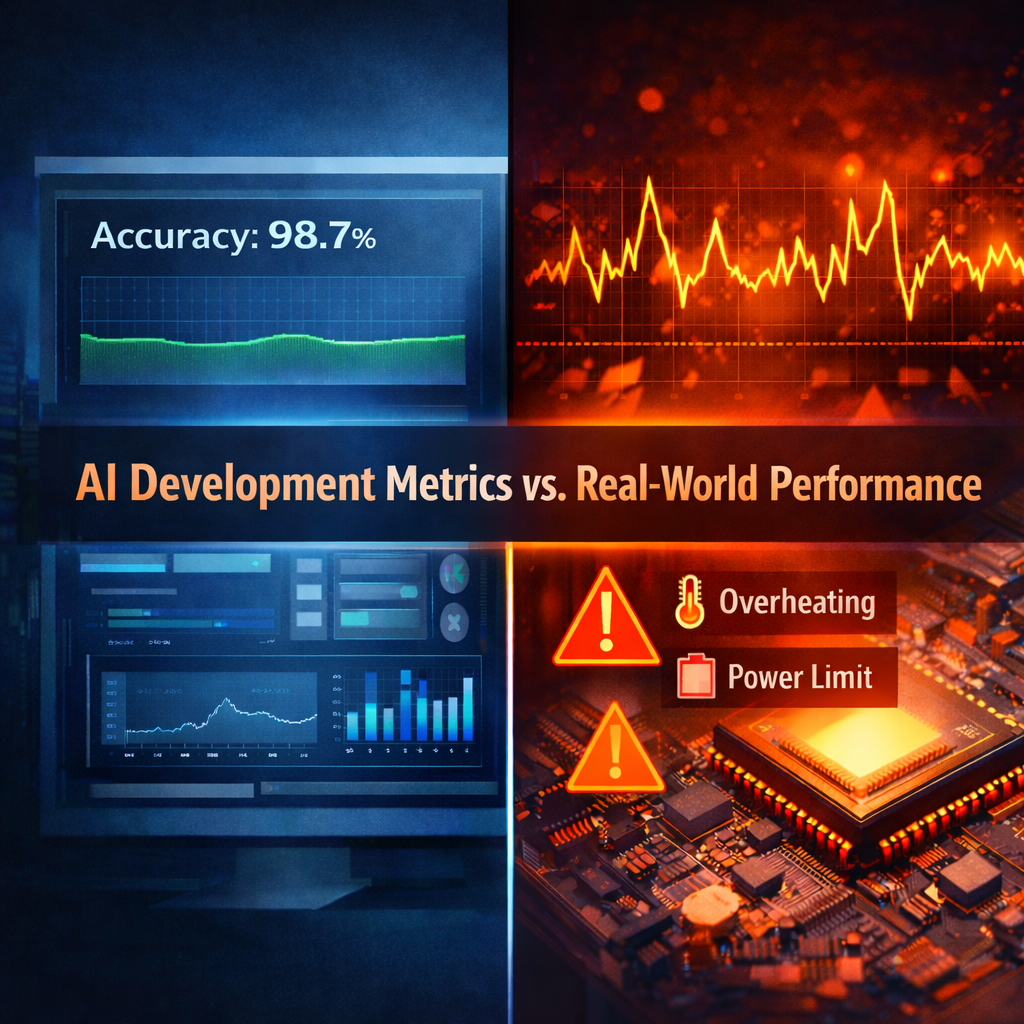
Artificial intelligence systems often appear highly effective during development. Models achieve strong benchmark scores, validation metrics improve over time, and performance looks predictable within controlled environments.
But once those same systems are deployed into real-world conditions, results frequently diverge. Latency increases beyond acceptable thresholds, power consumption becomes unsustainable, and performance degrades in ways that were not visible during testing.
In many cases, teams assume the issue lies in the model itself. Retraining cycles begin, architectures are adjusted, and new optimization strategies are explored. Yet the underlying problem is often not the model’s capability, but why AI systems fail in production and the metrics used to evaluate them.
Most AI performance metrics are designed for development environments, not production systems. As a result, they fail to capture the constraints that ultimately determine whether AI works in practice.
Why AI Performance Metrics Fail in Isolation
Traditional AI evaluation—and most AI performance metrics—focuses heavily on model-level metrics. Accuracy, precision, recall, and throughput provide useful signals during development, particularly when comparing architectures or validating improvements against a dataset.
These metrics are effective within controlled environments where inputs are consistent, compute resources are abundant, and system behavior is predictable.
However, production systems operate under very different conditions. AI models must function as part of a broader system that includes hardware constraints, real-time requirements, and environmental variability. When performance is measured in isolation from these factors, the resulting metrics can be misleading.
An AI model that performs well in a lab setting may fail to meet the operational requirements of the system in which it is deployed. Accuracy alone doesn’t determine whether a model can respond quickly enough, operate within power limits, or handle variability in real-world inputs.
Why AI Performance Metrics Break Down in Production Environments
The gap between AI development metrics and production performance is driven by constraints that are often invisible during model evaluation.
Latency is one of the most immediate factors. Many AI systems must operate in real time, where delayed responses can degrade user experience or compromise system behavior. Average latency measurements can obscure variability, making systems appear stable during testing while failing to meet strict timing requirements in production.
Memory and bandwidth constraints also play a critical role. Models evaluated in high-performance environments may rely on data movement patterns that are impractical on edge devices or embedded systems. In many cases, the cost of moving data exceeds the cost of computation itself—a reality that increasingly defines performance in edge and embedded systems—introducing bottlenecks that traditional metrics do not capture.
Power consumption introduces another layer of complexity. In addition to speed, AI performance in production is about efficiency. A model that achieves high throughput may still be unusable if it exceeds the power budget of the device it runs on.
Environmental variability further complicates performance. Real-world systems must handle fluctuating inputs, sensor noise, and changing conditions that are rarely reflected in curated datasets. Metrics derived from static test data often fail to predict how models will behave under these dynamic conditions.
Taken together, these constraints reveal a fundamental issue: most AI performance metrics don’t measure system behavior. They measure isolated model behavior under ideal conditions.
The Missing Layer: System-Level Performance
Production AI is defined by how models behave within the context of the systems they are part of, requiring a shift toward system-level orchestration and performance thinking.
Instead of asking how accurate a model is, teams need to evaluate how it behaves within the constraints of the target environment. This includes understanding how models interact with hardware, how data moves through the system, and how performance holds up under real-world conditions.
System-level performance introduces new dimensions that traditional metrics often ignore. Predictability becomes more important than peak performance, efficiency becomes as critical as speed, and reliability under varying conditions becomes a primary requirement rather than an afterthought.
Without this perspective, teams risk optimizing for AI performance metrics that don’t translate into meaningful outcomes in production.
What Actually Matters in Production AI
The definition of performance changes as AI systems move into production environments:
• Predictable latency, not just average speed
• Consistent response times under real-world conditions
• Performance per watt, especially in power-constrained environments
• Efficient data movement, where bandwidth and memory behavior often define system limits
• Hardware alignment, ensuring models are designed for the target processor and system architecture
• Resilience to variability, maintaining performance across changing inputs and environments
These factors collectively define whether AI systems work in production—and they’re rarely captured by traditional evaluation metrics.
Why This Changes How AI Should Be Built
When performance is defined by real-world constraints, AI development itself must change. Rather than optimizing models in isolation and adapting them later, teams need to incorporate deployment conditions into the development process upfront. Hardware capabilities, latency targets, and power budgets become design inputs rather than downstream considerations.
This constraint-first approach reshapes AI model development, shifting it from an experimental process to an engineering discipline grounded in real-world requirements. It also reduces the need for repeated iteration cycles driven by deployment failures. When AI models are built with production environments in mind, the gap between development and deployment narrows significantly.
Bridging the Gap Between AI Performance Metrics and Reality
The limitations of traditional AI performance metrics are becoming more visible as AI systems move beyond controlled environments and into production. This shift is forcing a reevaluation of how performance is measured and how systems are designed. Metrics that once served as reliable indicators of progress are no longer sufficient on their own.
What matters now is whether AI systems can operate within the constraints that define real-world environments. Approaches that incorporate hardware behavior, system-level constraints, and real-world variability into the development process are beginning to close this gap. By aligning model development with production conditions, teams can build systems that not only perform well in theory, but also work reliably in practice.
This shift marks a turning point in how AI systems are evaluated. Performance can no longer be defined by isolated metrics alone, but by how systems behave under real-world constraints.
What AI Performance Metrics Miss — and What Comes Next
The future of AI performance won’t be defined by better metrics alone, but by a better understanding of what those metrics fail to capture. As AI systems continue to expand into real-world environments, success will depend on the ability to measure and optimize performance at the system level, not just the model level.
The models that succeed in production won’t simply be the ones that achieve the highest benchmark scores, but the ones that operate reliably within the constraints of the systems they’re designed for.
ModelCat’s approach reflects this shift by incorporating real hardware constraints directly into the model development process, enabling teams to evaluate and optimize performance in the environments where models will ultimately run.
Ready to improve how your AI performance metrics translate to real-world systems? Take a test drive of ModelCat to see how your AI models perform under production constraints before deployment.