
AI failures rarely begin with bad models. More often, they begin with good models placed into environments they were never designed to survive.
AI models perform impressively in controlled development settings. Benchmarks are strong, validation accuracy meets targets, and teams gain confidence as experiments converge and performance curves flatten in the right direction. From a technical standpoint, everything appears ready.
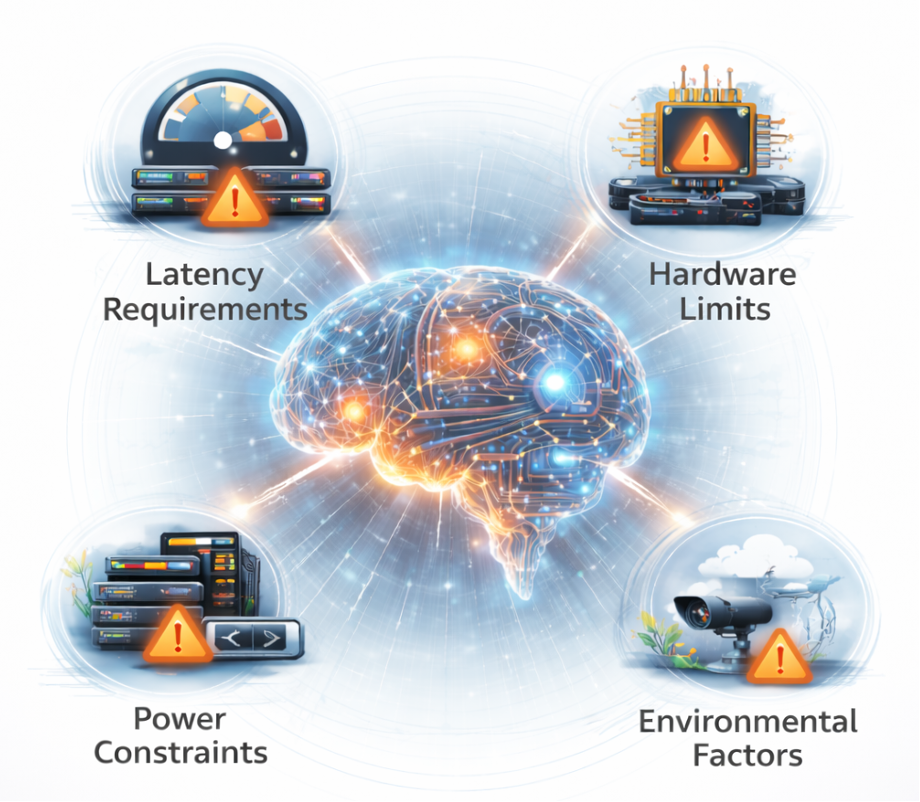
However, once AI deployment begins, the system often struggles. Latency increases beyond acceptable thresholds, hardware limitations surface, and power consumption exceeds design budgets. Environmental variability introduces noise that wasn’t present in training data, and what looked production-ready in theory becomes fragile in practice.
When AI deployment falters, teams often revisit the model itself. They retrain, adjust hyperparameters, and experiment with larger architectures. But in many cases, the issue was never AI model quality. It was the disconnect between the model and operational reality.
The Limits of Model-Centric AI Deployments
Modern AI development workflows are optimized around model performance. Teams invest heavily in dataset curation, architecture selection, training pipelines, and evaluation metrics. Accuracy becomes the dominant signal of progress. If the model improves, the AI project is assumed to improve.
This model-centric mindset is understandable. The model is the intelligence layer of the system, so improving it feels synonymous with improving the outcome. However, production systems do not reward theoretical accuracy alone. They reward reliability under constraint.
A model that achieves high accuracy in a lab environment can still fail in AI deployment if it can’t operate within the physical and economic boundaries of its target setting. In production, success depends not only on predictive performance, but on how that performance holds up under real-world conditions.
Those conditions are rarely abstract, including hard limits such as:
• Available compute resources
• Memory constraints
• Latency requirements
• Power budgets
• Connectivity reliability
• Environmental variability
When these constraints are treated as downstream implementation details rather than upstream design inputs, friction is inevitable. The model may be correct in isolation, but the system as a whole becomes unstable, expensive, or unusable. Rather than being a mathematical AI failure, it’s actually an architectural failure.
Where AI Production Systems Break
AI systems don’t operate in idealized environments. They operate inside physical infrastructure, business processes, and unpredictable surroundings. These layers introduce complexity that training environments often mask. As discussed in our analysis of designing AI at the edge, constraints are structural conditions that determine whether AI systems succeed in production.
In fact, industry research shows how common this gap between model performance and operational success has become. According to a RAND Corporation analysis, more than 80% of AI initiatives fail to deliver impact or scale—a rate much higher than typical IT project failure rates. This means that even models that perform well in controlled conditions often confront barriers that go beyond predictive accuracy.
Consider how breakdowns typically occur. In latency-sensitive environments, a model that performs well in cloud-based testing may respond too slowly once integrated into a real-time workflow. Even modest increases in inference time can degrade user experience or disrupt downstream processes. Accuracy becomes secondary if the output arrives too late to be actionable.
In hardware-constrained deployments, AI models designed with generous compute assumptions may struggle when ported to limited devices. Memory ceilings, processor capabilities, and thermal constraints create bottlenecks that were invisible during development. Performance drops or costs escalate as teams attempt to compensate.
Power limitations introduce another layer of constraint. In embedded or edge environments, energy consumption is not theoretical. It determines viability. A model that drains power faster than the system can sustain becomes impractical, regardless of how well it performs in testing.
Environmental variability further complicates matters. Controlled datasets rarely capture the full variability and unpredictability of real-world conditions. Lighting shifts, background noise fluctuates, sensors degrade, and network reliability changes. Models trained under stable assumptions may falter when confronted with unpredictable inputs.
None of these breakdowns imply poor AI model design. They reveal a deeper issue: the system is designed around those constraints, but the model often isn’t.
The AI Deployment Gap
A recurring pattern in AI initiatives is the separation between model development and deployment design. Projects often follow a familiar arc: define the problem, build and train the model, validate performance, and then integrate into production.
This separation shows up in industry outcomes as well: multiple surveys indicate that roughly 70% to 90% of AI pilots never progress to full production or deliver expected outcomes. That means most projects stall not because of model theory, but because AI deployment realities were not addressed up front.
By the time deployment considerations enter the discussion, foundational assumptions have already been made. Hardware requirements are fixed, latency expectations are inherited rather than defined, and infrastructure costs are accepted as tradeoffs rather than constraints.
This sequencing creates an AI deployment gap. Teams optimize for performance in isolation, and then retrofit the model to fit operational reality. Compression techniques, architectural changes, and infrastructure adjustments become reactive efforts rather than deliberate design choices.
The result is friction—not because the AI model is weak, but because it was optimized for the wrong context. When deployment readiness is treated as a late-stage concern, even strong models struggle to scale sustainably.
AI Is a System, Not Just a Model
Production AI is not defined by a single artifact. It’s defined by how multiple elements operate together. These include the AI model, the hardware platform, data ingestion pipelines, networking layers, user interfaces, and the surrounding environment.
Evaluating model accuracy in isolation overlooks a fundamental reality: real-world performance depends on how the entire system behaves under constraint. This systems-first framing builds directly on the argument that AI must be designed for constraints from the outset, not retrofitted to them later.
Shifting from a model-centric mindset to a systems-level perspective changes the framing of core questions. Instead of asking, “How accurate can we make the model?” teams begin asking, “How will this system behave under the constraints of its target environment?”
This reframing introduces tradeoffs that must be addressed explicitly:
• How much latency is acceptable for the user experience?
• What level of compute can the hardware reliably support?
• How should performance degrade under variability or partial failure?
• What cost structure is sustainable at scale?
These engineering details are defining features of whether the AI project succeeds or fails in production.
Production Readiness as a Core Requirement
AI that works only in controlled environments is incomplete and misleading. AI that functions reliably under real-world constraints is production-ready.
Achieving that level of readiness requires acknowledging AI deployment constraints alongside traditional model metrics from the outset. Accuracy remains important, but it can’t stand alone as the primary success criterion. Deployment readiness must sit beside it as an equally weighted requirement.
This means designing systems that openly recognize tradeoffs, prioritize reliability over theoretical perfection, and validate assumptions against real-world conditions early in the development process. It also requires clarity around decision ownership. Someone must be accountable for defining latency targets, hardware assumptions, environmental tolerance, and cost boundaries.
When AI deployment readiness is treated as foundational rather than optional, teams avoid the common trap of building technically impressive systems that can’t survive outside controlled conditions. They reduce the risk of investing heavily in models that function more like experiments than durable products.
From Theory to Operational Reality
Most AI deployment failures stem from systems that were optimized for benchmarks rather than environments, and it’s well documented beyond academic theory. A widely cited MIT report found that only about 5% of generative AI initiatives deliver measurable bottom-line impact quickly, with the vast majority stalled due to integration and operational challenges rather than model performance issues.
Operational reality isn’t an obstacle to innovation, but rather the context within which innovation must operate. Constraints related to hardware, latency, power, and variability are not inconveniences to be resolved after the fact. They’re structural conditions that shape what is viable.
Bridging the gap between technical ambition and operational reality requires a shift in mindset. Instead of treating AI deployment as a final stage, it must become an organizing principle from the beginning. Rather than celebrating AI model performance in isolation, teams must evaluate how that performance holds up under constraint.
AI becomes far more likely to endure in production when it’s designed as a system rather than a model and, in practice, endurance is what distinguishes theoretical capability from real-world impact.
Designing AI for the Real World
If your AI project looks strong in theory but struggles in deployment, it may not be a model problem. It may be a systems problem.
From hardware limits and latency expectations to environmental variability and cost realities, production-ready AI requires clarity around constraints from the start. These factors shape what is viable long before the first AI model is trained.
If you're rethinking how your team approaches AI deployment, it may be time to evaluate not just model performance, but operational alignment. Request a demo to see how AI systems can be designed with real-world constraints in mind from day one.