
AI models today are effectively locked to the hardware environments they were built for. Teams invest millions to train and optimize models, only to discover that moving those models to a new processor, device, or system often requires starting over or navigating complex porting processes that introduce new constraints and tradeoffs.
This limitation is one of the biggest bottlenecks in production AI. As hardware ecosystems evolve and new silicon platforms emerge, the inability to move models freely across environments slows innovation, increases costs, and constrains what AI systems can do in practice.
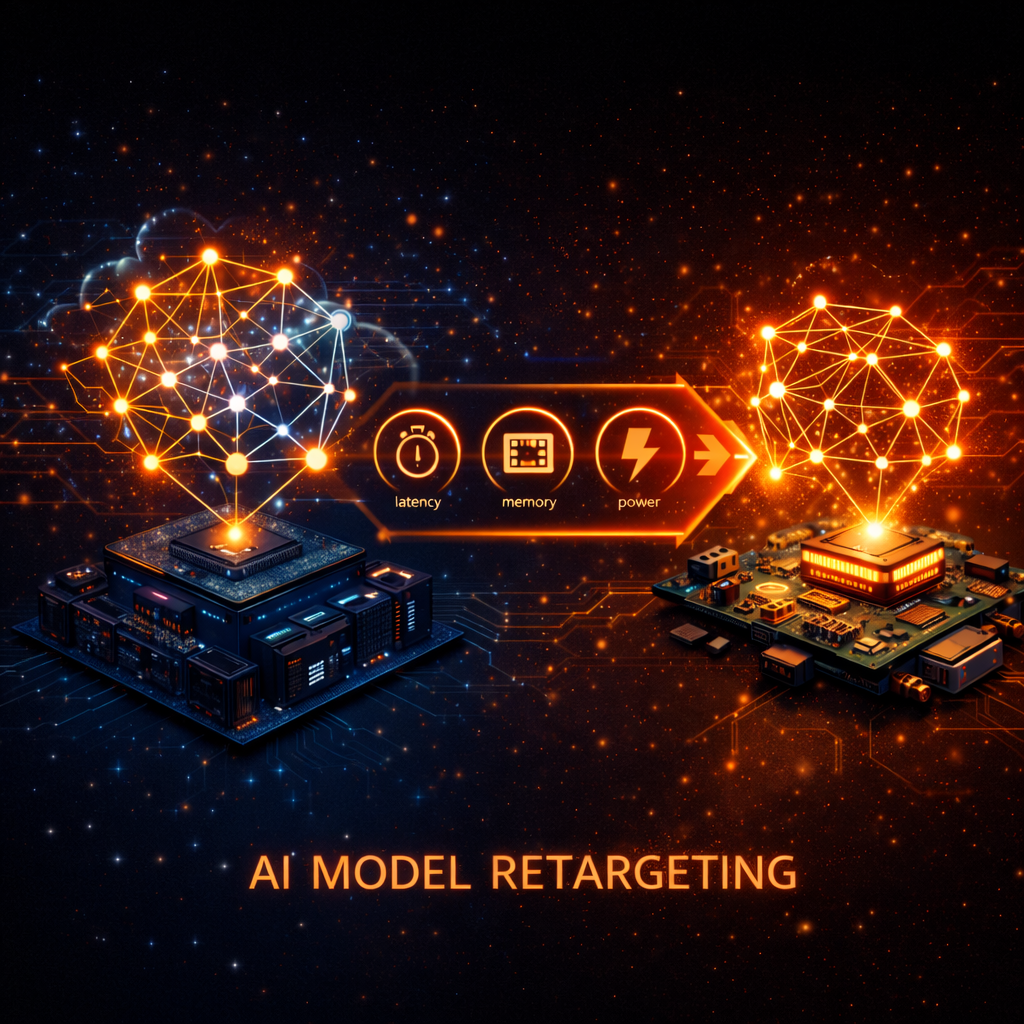
ModelCat has introduced a new agentic capability to solve this problem: AI model retargeting, powered by its AI Model Retargetor.
AI Model Retargetor retargets trained models to new hardware environments without restarting development from scratch. Instead of rebuilding models for each platform, it moves trained models across processors and systems quickly, while preserving performance within real-world constraints.
This introduces a new level of model portability that enables teams to optimize for cost, adopt next-generation hardware, and scale AI systems without compromise. AI Model Retargetor sits alongside ModelCat’s AI Model Builder to give teams the ability to deliver production-ready AI from either their data or existing models.
The Hidden Problem in AI Deployment
The lifecycle of an AI system rarely follows a straight path from model training to stable production deployment. Hardware platforms evolve, product requirements change, and engineering teams frequently adapt systems to support new devices or performance targets.
Prototypes may begin on development hardware before moving to production devices with tighter constraints. A model initially designed for one processor architecture may later need to run on another. Products that expand into additional markets may need to support multiple device configurations, each with different compute capabilities, memory limits, and power budgets.
Each of these transitions introduces constraints that influence how models perform in production. Memory availability may shrink dramatically between development and deployment environments. Latency requirements may tighten as systems move closer to real-time decision making. Power consumption becomes critical in embedded or edge AI deployments where devices must operate continuously with limited energy resources.
When these realities appear late in the development cycle, engineering teams often find themselves revisiting earlier design decisions. Models may need to be modified, compressed, or re-optimized to meet the new system requirements. What initially appeared to be a finished model becomes the starting point for another round of engineering work.
Why Traditional AI Workflows Break When Hardware Changes
Most AI development workflows were originally designed around relatively stable computing environments. Model training pipelines focus on improving accuracy, often within infrastructure that provides abundant compute resources and memory capacity.
Within these conditions, the typical workflow is straightforward. Teams construct and train a model, optimize it for performance, and prepare it for deployment. If the deployment environment remains consistent with the development environment, the transition to production can be relatively smooth.
But in real-world AI deployment scenarios, hardware environments rarely remain fixed. When the target platform changes, engineering teams may need to revisit architectural decisions, modify inference pipelines, or redesign portions of the model to operate within new constraints.
These adjustments often involve repeated rounds of testing and optimization. Small variations in processor architecture, memory layout, or hardware acceleration paths can significantly affect how models perform in production environments. Even when the core algorithm remains the same, adapting it to a different hardware platform can introduce significant engineering complexity.
As AI systems move toward edge and embedded deployments, this challenge becomes even more pronounced. Devices operating outside centralized infrastructure must function within strict system limits, making it difficult to rely on development workflows that assume abundant resources.
What Is AI Model Retargeting?
AI model retargeting is a capability developed by ModelCat that uses AI-in-the-loop to adapt models to new hardware environments without rebuilding them from scratch.
Instead of retraining an entirely new model for each deployment environment, retargeting iteratively modifies architecture configurations, compute behavior, and applies optimization strategies until the model operates within the constraints of the target system and user’s requirements.
Retargeting may involve adjusting architecture configurations, modifying how models use memory, adapting compute scheduling, or taking advantage of different hardware acceleration features. The goal is not simply to make the model executable on another device, but to enable it to perform reliably within the limits of the new environment and the user’s requirements, while allowing teams to adjust constraints across platforms as needed.
In practice, retargeting allows engineering teams to move models between deployment environments while preserving the functionality required by the application. Instead of rebuilding models each time hardware changes, teams can adapt existing models to match the capabilities of the target system.
This approach significantly reduces the engineering overhead required to support multiple deployment environments and allows AI systems to evolve alongside the hardware platforms that run them.
The Need for Model Portability
For AI teams, model portability has been desirable but difficult to achieve in practice. In most workflows, models become tightly coupled to the hardware they were originally built for, making platform changes expensive, slow, and operationally complex to execute.
While portability makes it easier to move models across software ecosystems, it does not guarantee successful deployment. A model that runs on another device is not necessarily a model that runs well.
Hardware environments differ widely in their capabilities. Differences in memory capacity, compute architecture and instruction sets, power availability, and hardware acceleration can all influence how a model performs once deployed. A portable model may technically execute on a new device while still failing to meet latency targets, throughput requirements, or energy constraints.
This is where portability reaches its limits. True model portability requires the ability to adapt models to the specific characteristics of the hardware environment. ModelCat’s AI model retargeting provides that deeper level of adaptation, allowing models to maintain performance as they move across deployment environments.
When retargeting becomes part of the development workflow, portability becomes more than a theoretical capability. It becomes a practical outcome.
How ModelCat Enables AI Model Retargeting
ModelCat enables AI model retargeting through its proprietary AI-driven system for generating, optimizing, and validating models against real deployment environments. Instead of treating hardware constraints as issues that appear late in the process, ModelCat incorporates those constraints directly into the model development workflow.
Using its proprietary AI-in-the-loop process, ModelCat constructs, trains, and validates machine learning models based on the behavior of real hardware systems. Rather than relying on manual tuning, repeated porting work, or vendor-specific runtime workarounds, the platform evaluates the constraints of the target environment and generates models designed to operate within those conditions.
This process considers several critical factors that shape AI deployment performance, including:
● Latency requirements
● Memory availability
● Power consumption
● Processor architecture
● Hardware acceleration capabilities
● Available compute resources
● Thermal limits
By incorporating real hardware constraints into an iterative, AI-in-the-loop process, ModelCat’s AI Model Retargetor continuously evaluates and adapts models through a series of optimization and testing cycles. Instead of relying on manual tuning or one-off adjustments, it applies its understanding of thousands of techniques to refine how a model performs within a specific hardware environment and set of user-defined requirements.
In practice, this allows teams to move beyond static optimization approaches. AI Model Retargetor works more like a team of skilled practitioners, systematically exploring tradeoffs across latency, memory, power, and compute behavior to identify configurations that perform reliably in production.
Instead of treating each new hardware target as a separate development effort, retargeting becomes an integrated, continuous part of the AI development lifecycle.
Retargeting and the Future of Production AI
As AI becomes more deeply integrated into products, infrastructure, and devices, the range of hardware environments supporting AI workloads continues to expand. Edge processors, embedded systems, and specialized accelerators are dramatically increasing the number of platforms capable of running AI systems.
At the same time, organizations expect AI capabilities to operate across multiple device types and performance tiers. A single AI application may need to function on development hardware, production devices, and future hardware generations.
This creates the need not just for portability, but for future-proofing. Models must be able to evolve with new hardware platforms, adapting to changes in compute architecture, memory systems, and performance requirements without requiring teams to start over.
This reality requires a shift in how AI systems are designed. Development workflows that assume a single deployment environment will struggle to keep pace with the diversity of modern hardware ecosystems.
ModelCat’s AI model retargeting makes more adaptable AI systems possible. By enabling models to adapt to the hardware environments in which they operate, retargeting reduces the friction between development and deployment while allowing engineering teams to support a wider range of systems without rebuilding models from scratch.
Closing the Gap Between AI Development and Deployment
Training a model is only one step in the lifecycle of an AI system. The real test of whether AI works comes when models are deployed into environments with real hardware constraints.
ModelCat’s AI Model Retargetor closes the gap between those stages by adapting models to new deployment environments without restarting development cycles. As hardware ecosystems continue to evolve, this gives organizations building production AI systems a new level of portability and flexibility.
Ultimately, the models that succeed in production will not simply be the ones that train well. They will be the ones that can adapt and run reliably wherever they are deployed.
ModelCat’s new AI model retargeting capability enables teams to move models across hardware platforms quickly, preserve performance within real system constraints, and unlock greater flexibility in how production AI systems are built, deployed, and scaled. Book a demo to see how it works. Book a demo to see how it works.